
QUARTERLY MONITORING REPORT
Human Rights Situation
in Somalia
Quarter II: 1 April–30 June 2026
PRIORITY CONCERNS
Renewed piracy and maritime insecurity • freedom of expression • gender-based violence • grave violations against children • forced evictions and the rights of internally displaced people
Prepared by the Coalition of Somali Human Rights Defenders (CSHRD)
Mogadishu, Somalia | August 2026
METHODOLOGICAL CAUTION
This report separates verified information, credible public reporting, allegations requiring independent investigation, and CSHRD’s advocacy recommendations. Inclusion of an allegation does not establish individual or institutional responsibility.
Executive summary
Somalia’s human rights environment deteriorated during the second quarter of 2026 amid a sharp renewal of piracy off Puntland, continuing restrictions on expression, gender-based violence, grave violations against children, and large-scale forced evictions affecting internally displaced people. These concerns intersect: insecurity at sea can raise transport and insurance costs; displacement increases exposure to exploitation and violence; and weak accountability enables abuses by both state and non-state actors.
The most visible new development was the late-April seizure of at least three vessels off Puntland. The attacks endangered crews and demonstrated organised logistical capacity, including apparent shore-based support. Publicly available sources reviewed for this report do not establish the user-reported allegation that named Puntland politicians or the United Arab Emirates financed the pirate groups. Those claims are serious and should be tested through an independent, evidence-led criminal and financial investigation, with due process and protection for witnesses.
Key findings
• At least three vessels were hijacked off Puntland in late April 2026. The crews faced prolonged captivity, lack of clean water and serious psychological harm.
• The piracy resurgence threatens the rights to life, security and livelihood. Any food-security effect should be monitored through port calls, freight and insurance costs, commodity prices and delivery delays; current public sources do not yet quantify a Somalia-wide reduction in food availability caused specifically by piracy.
• Forced evictions remained a major protection emergency. The Somalia Protection Cluster reported that more than 36,300 IDPs were affected by eviction incidents in April alone.
• Women and girls—especially those displaced—continued to face elevated risks of sexual and gender-based violence, while children remained exposed to recruitment, abduction, killing, maiming and sexual violence.
• Restrictions on journalists and artists persisted. The reported arrest of musician Khalid Kaamil in Hargeisa occurred in July 2026 and is therefore recorded as a post-quarter development, not a Quarter II incident.
Priority recommendations
• Establish an independent, internationally supported investigation into pirate command structures, financing, weapons supply, shore-based facilitation, ransom flows and any political or foreign links.
• Release anyone detained solely for peaceful journalism or artistic expression, disclose the legal basis for every detention, guarantee access to counsel and end security-agency interference with lawful expression.
• Immediately suspend evictions that lack notice, consultation, legal review, compensation, and safe alternative accommodation; restore or compensate destroyed property.
• Expand survivor-centred GBV services and enforce child-protection obligations, including referral and reintegration pathways for children formerly associated with armed groups.
• Where credible evidence meets the applicable legal threshold, governments should consider targeted measures—including Global Magnitsky-style sanctions—against individuals responsible for serious human rights abuses or significant corruption. Sanctions should follow documented, individualised findings and due process, not collective or familial association.
1. Scope and methodology
The reporting period is 1 April to 30 June 2026. CSHRD reviewed public reporting by international organisations, protection actors, specialist maritime bodies and reputable media. The report applies a human-rights framework grounded in the International Covenant on Civil and Political Rights, the Convention on the Rights of the Child, the Convention against Torture, the African Charter on Human and Peoples’ Rights, the Kampala Convention, international humanitarian law where applicable, and the UN Guiding Principles on Internal Displacement.
The report uses cautious attribution. ‘Documented’ indicates corroboration by a credible source; ‘reported’ means a source published the claim but CSHRD has not independently verified it; ‘alleged’ denotes a claim requiring further investigation. CSHRD sought to avoid prejudging criminal responsibility.
2. Renewed piracy and maritime insecurity
Documented developments
A concentrated series of hijackings occurred off Somalia’s Puntland coast in late April. The tanker Honour 25 was seized on 21 April, followed by a dhow on 25 April and the cement carrier Sward on 26 April. Maritime reporting warned vessels to exercise heightened vigilance within 150 nautical miles of the Somali coast between Mogadishu and Hafun. Reuters later reported that Honour 25 carried 17 crew members, including 10 Pakistani nationals, who experienced shortages of clean water and food during captivity.
The incidents reveal more than opportunistic crime. Reporting described armed boarding teams, an interpreter communicating with shipowners, use of hijacked dhows as motherships and apparent land-based logistical support. These indicators justify investigation into organisers, financiers, weapons suppliers, negotiators, safe havens and proceeds of crime.
Alleged political and foreign links
EVIDENCE STATUS
CSHRD has received or observed allegations that political actors in Puntland and foreign-linked security interests, including interests associated with the UAE, may have enabled or benefited from maritime insecurity. The sources reviewed for this issue are mainly collected from national and international reports.
The regional context makes scrutiny of foreign links legitimate. Policy research documents that the UAE played a central role in creating, financing and supervising the Puntland Maritime Police Force. The UAE’s unlawful acts and destablization of the region is confirmed by multiple sources. A lawful investigation should nevertheless examine whether weapons, training, intelligence, vessels, personnel or resources were diverted; whether politically connected intermediaries protected pirate networks; and whether any public or private actor benefited from the resulting insecurity.
Any investigation should examine all plausible hypotheses rather than assume a predetermined conclusion. These include organised criminal profit, local protection networks, diversion of arms, corruption, reduced naval deterrence, regional conflict spillover and deliberate manipulation of maritime insecurity. It should also assess CSHRD’s concern that an actor may seek to exploit piracy narratives to weaken Somalia’s statehood or justify foreign security activity in Somali territorial waters without valid Somali consent.
Human-rights and humanitarian impact
• Seafarers: abduction, hostage-taking, threats to life and physical integrity, deprivation of water and food, and trauma affecting crew members and families.
• Coastal communities: risk of militarisation, reprisals, criminal recruitment and disruption of lawful fishing and trade.
• Food security and livelihoods: piracy may deter port calls and increase insurance, freight and security costs. This can raise prices or delay imports, but a causal, nationwide food-security impact requires verified port, trade and market data.
• Sovereignty and rule of law: unlawful maritime activity and uncoordinated foreign action can erode Somalia’s authority and create further protection risks.
CSHRD call for action
CSHRD calls for a thorough, impartial and internationally supported criminal investigation, led with Somali ownership and appropriate UN, INTERPOL, maritime and financial-intelligence assistance. The inquiry should follow money and weapons, preserve electronic evidence, protect witnesses, publish findings consistent with fair-trial rights, and pursue all responsible actors regardless of political office or foreign affiliation.
3. Freedom of expression: journalists and artists
Independent journalism and peaceful artistic expression are protected forms of expression. Arrest without prompt disclosure of a lawful basis, incommunicado detention, denial of counsel, or punishment for criticism can violate the rights to liberty, fair process and freedom of expression.
During the wider 2026 period, media workers and artists continued to operate in an environment marked by arrest, intimidation and judicial pressure. Because individual cases require precise dates and documentation, CSHRD recommends maintaining a verified incident register recording the victim’s name, profession, arresting authority, date and place, alleged offence, access to counsel, court appearances, release date and any mistreatment.
Post-quarter update: Khalid Kaamil
OUTSIDE THE REPORTING PERIOD
Somali media reported in July 2026 that Somaliland intelligence officers arrested musician Khalid Mohamud Abdillahi, known as Khalid Kaamil, at his home in Hargeisa over an unreleased song believed to criticise israel’s occupation of Palastine. This occurred after 30 June and is included only because it illustrates the continuing pattern of restrictions relevant to this report.
CSHRD calls on the Somaliland authorities to disclose the legal basis for the arrest; ensure immediate access to family, counsel and medical care; bring any lawful charge promptly before an independent court; and release him if he is held solely for peaceful artistic expression. Authorities should not use vague security, public-order or morality provisions to silence criticism.
4. Gender-based violence
Women and girls in Somalia continue to face rape, intimate-partner violence, forced and child marriage, sexual exploitation and conflict-related sexual violence. Displacement, poverty, minority status, disability and lack of documentation can increase exposure and reduce access to justice. Evictions can compound these risks by separating families, destroying privacy, moving survivors away from services and forcing women and girls into unsafe shelter arrangements.
CSHRD is concerned that GBV risks remained high during Quarter II. However, claims that incidence ‘increased’ should be supported by comparable reporting data and interpreted carefully: higher case numbers may reflect greater violence, improved disclosure, expanded services or changes in geographic coverage. Under-reporting remains severe because of stigma, insecurity, fear of retaliation and weak justice mechanisms.
Required response
• Fund confidential clinical care, psychosocial support, safe shelter, legal assistance and livelihood support without requiring survivors to pursue criminal cases.
• Train police, prosecutors, judges, health workers and camp managers in survivor-centred, child-sensitive referral and evidence protocols.
• Prevent retaliation and harmful informal settlements; ensure survivors can choose whether and how to engage justice mechanisms.
• Publish anonymised, disaggregated data while protecting survivor identity and informed consent.
5. Children’s rights
Somali children remain exposed to grave violations in armed conflict, including recruitment and use, killing and maiming, abduction, sexual violence, attacks on schools and hospitals, and denial of humanitarian access. Children associated with armed groups must be treated primarily as victims and transferred rapidly to civilian child-protection services. Security detention should never replace rehabilitation and reintegration.
Forced eviction also violates or threatens children’s rights to adequate housing, education, health, protection, water and family life. Destruction of shelters and repeated displacement can interrupt schooling, expose children to separation and exploitation, and worsen malnutrition and disease risks.
Recommendations on child protection
• End recruitment and use of children by all armed actors and prosecute responsible commanders through fair proceedings.
• Apply the 2014 Standard Operating Procedures for reception and handover of children formerly associated with armed groups.
• Provide safe learning spaces, documentation, nutrition, health care and family-tracing services in eviction-affected communities.
• Ensure independent monitoring of detention sites and prohibit torture, coercive interrogation and military prosecution of children.
6. Forced evictions and IDP rights
Forced evictions remained one of the clearest Quarter II protection concerns. The Somalia Protection Cluster reported that eviction incidents affected more than 36,300 IDPs in April 2026 alone. Many displaced families lost makeshift shelters and possessions and faced renewed displacement without adequate alternatives. A May 2026 EUAA report also documented the legal framework, recent eviction trends and their impact in Mogadishu.
Eviction is not automatically lawful merely because land is publicly or privately claimed. Authorities must provide genuine consultation, reasonable notice, access to information and legal remedies, protection from violence, and adequate alternative accommodation or compensation. Evictions must not result in homelessness or expose people to further rights violations.
Allegations involving senior officials and business interests
ACCOUNTABILITY STANDARD
CSHRD is concerned by allegations that politically connected officials and business actors have benefited from land clearance and forced evictions in Mogadishu. Publicly available material reviewed for this report confirms the broader eviction crisis.
These allegations are not confined to private complaints. Somali media have reported affected families directly accusing President Hassan Sheikh Mohamud of land seizures, and have reported a legal filing naming the President and a bank described by the outlet as connected to his family.
Wider reporting has documented public anger over government-led evictions. A complaint, accusation or media report is not a judicial finding, but the consistency and seriousness of the accounts justify urgent independent scrutiny and a meaningful right of reply.
CSHRD calls for an independent land and eviction inquiry with authority to preserve title records, identify beneficial owners, trace proceeds, review compensation and relocation, hear affected communities safely and recommend restitution, prosecution or administrative sanctions. The federal government and Banadir authorities should immediately publish land-transfer decisions affecting IDP settlements.
Targeted sanctions
CSHRD urges states operating Global Magnitsky-style regimes to assess properly documented cases of serious human rights abuse and significant corruption in Somalia. Any designation proposal should identify the responsible individual or entity, the qualifying conduct, credible evidence, command or financial links, and the requested measure. Family members should not be targeted merely because of kinship; but being actively involved, therefore, the president and associates should face Magnitsky sanctions.
7. Consolidated recommendations
To the Federal Government of Somalia
• Protect IDPs from unlawful eviction; order a moratorium on non-compliant evictions and establish an accessible restitution and compensation mechanism.
• Invite independent scrutiny of piracy financing, maritime-security contracts, arms flows and political interference; ensure prosecutions meet fair-trial standards.
• Protect journalists, artists and human rights defenders; repeal or amend vague laws used to criminalise peaceful expression.
• Fund survivor-centred GBV services and child-protection systems and publish disaggregated implementation data.
To Somalia’s Puntland and Somaliland regional authorities
• Puntland should investigate and dismantle shore-based piracy networks, disclose results and cooperate with federal and international investigators.
• Somaliland should end arbitrary detention for journalism and art, guarantee access to counsel and independent courts, and investigate abuse by security agencies.
To international partners
• Support Somali-led, rights-compliant maritime investigations, financial intelligence, prosecution capacity and coastal livelihoods; do not use piracy as a pretext for violating Somali sovereignty.
• Condition security assistance on transparent vetting, civilian oversight, end-use monitoring and accountability for violations.
• Fund legal aid, GBV response, child protection, eviction monitoring and durable solutions for IDPs.
• Assess targeted sanctions only against persons for whom credible, individualised evidence meets statutory thresholds; coordinate designations with accountability and asset-recovery strategies.
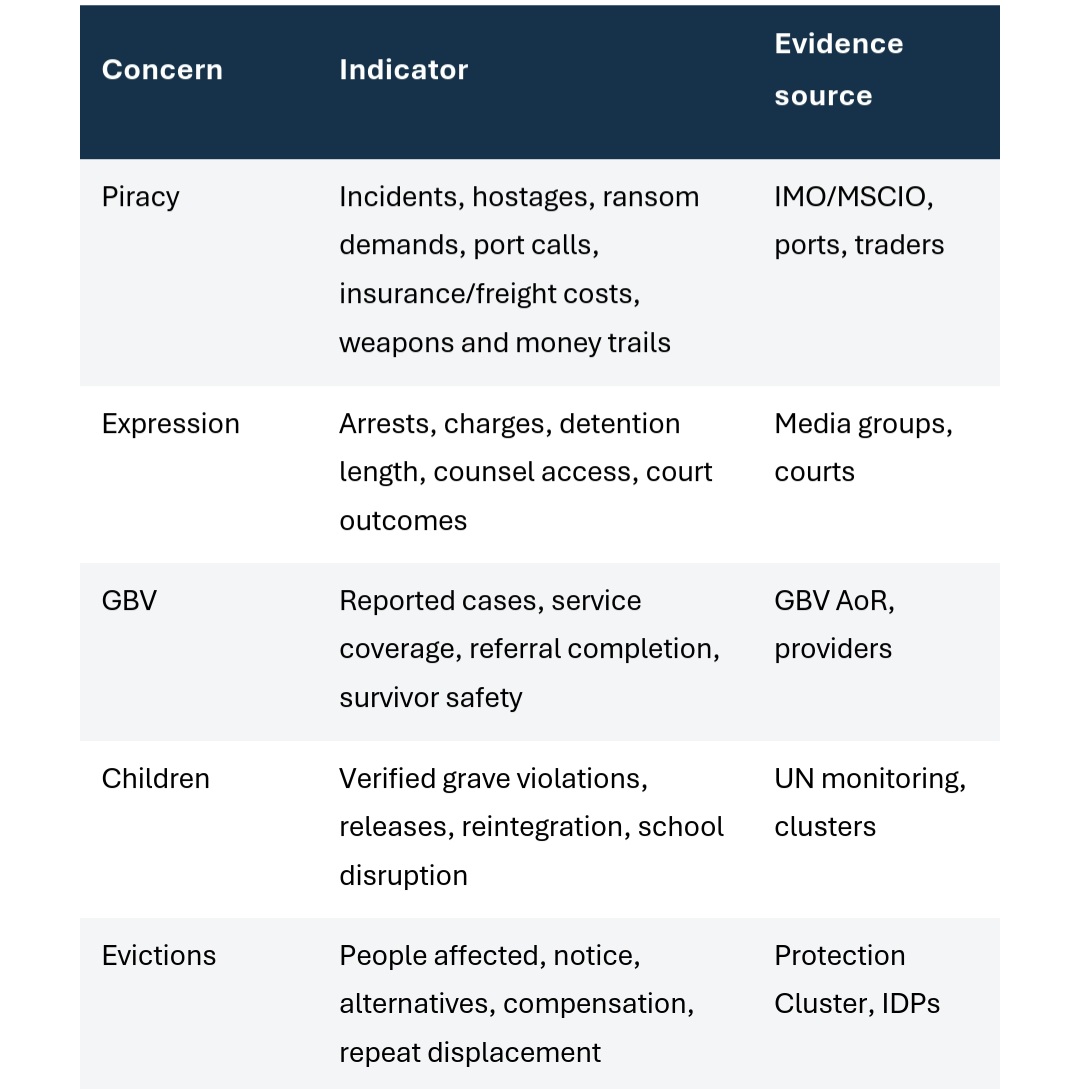
8. Monitoring indicators for Quarter III
Sources and further reading
1. The Guardian, ‘Fears of resurgence in Somali piracy after three vessels hijacked in a week’ (28 April 2026). https://www.theguardian.com/world/2026/apr/28/fears-resurgence-somalia-piracy-three-vessels-hijacked-past-week
2. Reuters, ‘Families of Pakistani hostages held by Somali pirates for 23 days call for their rescue’ (13 May 2026). https://www.reuters.com/world/asia-pacific/families-pakistani-hostages-held-by-somali-pirates-23-days-call-their-rescue-2026-05-13/
3. Somalia Protection Cluster, April 2026 Newsletter (published 7 May 2026). https://reliefweb.int/report/somalia/somalia-protection-cluster-april-2026-newsletter
4. Somalia Protection Cluster, June 2026 Newsletter (published 14 July 2026). https://reliefweb.int/report/somalia/somalia-protection-cluster-newsletter-june-2026
5. EUAA, Somalia: Displacement in Mogadishu—Displacements, Evictions, Prison Conditions, and Access to IDs (29 May 2026). https://www.euaa.europa.eu/publications/coi-report-somalia-displacement-mogadishu
6. Human Rights Watch, World Report 2026: Somalia. https://www.hrw.org/world-report/2026/country-chapters/somalia
7. Amnesty International, Somalia country report. https://www.amnesty.org/en/location/africa/east-africa-the-horn-and-great-lakes/somalia/report-somalia/
8. Hiiraan Online, ‘Somaliland detains musician over unreleased song about Jerusalem’ (10 July 2026). https://www.hiiraan.com/news4/2026/Jul/205646/somaliland_detains_musician_over_unreleased_song_about_jerusalem.aspx Included only as a post-quarter update.
9. Washington Institute, ‘Fighting Pirates and Terror: The Development of the Puntland Maritime Police Force, 2010–2023’. https://www.washingtoninstitute.org/policy-analysis/fighting-pirates-and-terror-development-puntland-maritime-police-force-2010-2023 Documents the UAE role in creating, financing and supervising the PMPF; it does not establish UAE financing of pirates.
10. Horn Observer, ‘Opposition Meets Evicted Families Amid Rising Land Grabs in Mogadishu’ (28 August 2025). https://hornobserver.com/articles/3471/ Reports accusations by affected families; accusations are not judicial findings.
11. Horn Observer, ‘Landmark Human Rights Case Against Somali President and Premier Bank’ (3 February 2025). https://hornobserver.com/articles/3169/Landmark-Human-Rights-Case-Against-Somali-President-and-Premier-Bank Reports a legal filing and related allegations; filing a case does not establish liability.
12. U.S. Department of the Treasury, Global Magnitsky sanctions framework (21 December 2017). https://home.treasury.gov/news/press-releases/sm0243 Authoritative background on targeted sanctions for serious human rights abuse and corruption.
ABOUT THIS REPORT
This report is intended for advocacy and protection analysis. It does not make judicial findings. CSHRD encourages victims, witnesses, authorities and partners to submit corrections and verifiable additional information through secure channels.
For media inquiries: info@cshrds.org