
REFORMING SOMALIA’S LEGAL SYSTEM
A Comprehensive Review of Legal Sources, Jurisprudential Gaps, and Compliance with International Human Rights Standards
LEGAL RESEARCH REPORT — SOMALIA
Geographical scope: Federal Republic of Somalia and Federal Member States, with Somaliland addressed separately where legally relevant
Historical coverage: Origins to October 2026
Language: English | Target publication length: 40–60 pages
Prepared for CSHRD institutional review 29 October 2026
Publication status and disclaimer
This document is a legal research report prepared for the Coalition of Somali Human Rights Defenders (CSHRD). It is not yet a final, independently validated legal opinion. It establishes the report architecture, research questions, initial legal inventory, preliminary analysis, gap matrix, and proposed reform roadmap. Before publication, CSHRD should verify all primary legal texts, amendments, official gazette records, authoritative Somali-language versions, case citations, and treaty status against original sources.
The report distinguishes: (i) enacted law and its formal status; (ii) official institutional claims about the law; (iii) judicial interpretation; (iv) implementation in practice; and (v) CSHRD’s analysis and recommendations. A source’s presence on a government or repository website does not, by itself, resolve questions of enactment, promulgation, territorial application, amendment, or repeal.
The term “Somalia” is used for the Federal Republic of Somalia and its federal constitutional framework. Somaliland is addressed separately where its institutions, constitutional order, or claimed legal status require distinct treatment. This report does not determine questions of international recognition or territorial sovereignty.
Research cut-off and verification labels
Label Meaning
Verified primary source An official legal text, treaty-depository record, court judgment, gazette or institutional document inspected directly.
Corroborated secondary source A reputable international organisation, academic institution or legalinformation service summarising the law.
Verification required A material point where the authoritative text, current status, territorial application, or implementation evidence remains to be checked.
Analytical proposition A research hypothesis or interpretation that must be tested against primary sources and evidence.
Recommendation A proposed reform, not a statement of existing law.
The research cut-off is 29 October 2026. Where a source published by that date cannot be independently checked against the original underlying document, this draft flags the limitation rather than presenting the point as settled.
Contents
• Executive Summary
• 1. Introduction, Purpose and Scope
• 2. Historical Development of Somali Law
• 3. Constitutional Framework and Constitutional Status
• 4. Sources of Law: Sharia, Xeer and Statutory Law
• 5. Criminal Law and Inherited Legislation
• 6. Courts, Judicial Practice and Jurisprudence
• 7. International and Regional Human Rights Obligations
• 8. Thematic Human Rights Compliance Review
• 9. Federalism, Legal Pluralism and Territorial Variation
• 10. Findings: Legal and Jurisprudential Gaps
• 11. Reform Options and Implementation Roadmap
• 12. Conclusion
• Annex A. Preliminary Legal Inventory
• Annex B. Legal Gap Analysis Matrix
• Annex C. Jurisprudence Extraction Template
• Annex D. Stakeholder Interview Guide
• Annex E. Source Register and Verification Checklist
Executive Summary
Somalia’s legal system is plural, historically layered, and institutionally uneven. It includes constitutional and statutory law, Islamic law (Sharia), Somali customary law (Xeer), and legal materials inherited from colonial administration and the post-independence state. These sources do not operate as a single uniform system in every location. Their interaction depends on constitutional provisions, legislation, judicial jurisdiction, local practice, institutional capacity, security conditions, and the availability of formal remedies.
The central purpose of this report is to map the principal legal sources applicable in the Federal Republic of Somalia and its Federal Member States; assess the status and human-rights implications of inherited and contemporary legislation; examine judicial reasoning and jurisprudential accessibility; identify gaps between legal guarantees and implementation; and propose reforms grounded in Somalia’s constitutional framework and applicable international obligations.
A priority is the current status of the constitutional framework. The Federal Government’s Office of the Prime Minister describes amendments to Chapters 1–4 as approved in March 2024, while the Presidency and other official sources describe a constitution approved by Parliament on 4 March 2026 and signed on 8 March 2026 as the permanent Constitution. Independent analysis also documents objections by some political actors and Federal Member States. The report therefore treats constitutional status, procedure, and territorial acceptance as a high-priority verification issue, rather than assuming that competing institutional accounts are legally identical.
A second priority is criminal legislation. The Penal Code approved in 1962 entered into force in 1964; the Criminal Procedure Code dates to 1963. These instruments remain significant in legal analysis, but a publication-ready report must verify amendments, subsequent legislation, repeal provisions, and divergent regional application article by article. The age of a law is not itself proof that every provision is invalid or incompatible with human rights. The appropriate test is a provision-specific assessment of legality, necessity, proportionality, equality, procedural fairness, and consistency with binding obligations.
The report identifies areas requiring systematic scrutiny: criminal offences and penalties; arrest and detention; torture prevention and investigation; prison oversight; juvenile justice; gender equality and protection from violence; freedom of expression and media regulation; judicial independence; access to legal aid; customary dispute resolution; and consistency between federal and state-level rules. It also stresses that the legal position in Somaliland must be documented separately rather than folded into federal law without explanation.
The preliminary reform agenda is to: (1) establish a verified legal inventory; (2) clarify the constitutional and legislative status of each instrument; (3) conduct a human-rights audit of priority laws; (4) improve publication and accessibility of judgments; (5) strengthen judicial independence and procedural safeguards; (6) develop rights-compatible and contextsensitive interfaces between formal courts and customary mechanisms; (7) improve harmonisation while respecting constitutional allocations of power; and (8) create a measurable, participatory implementation plan.
Principal preliminary findings
• Constitutional status and amendment procedure must be verified using authoritative texts, official records, and documented institutional positions.
• The Penal Code, Criminal Procedure Code and prison-related laws warrant provision-by-provision review; their dates alone do not establish the status of every provision.
• Published judgments and accessible case law are essential to any genuine jurisprudential assessment; legal commentary cannot substitute for verified judgments.
• Sharia and Xeer should be analysed accurately and respectfully while examining the human-rights consequences of specific rules and practices.
• Federal and regional differences require a jurisdiction-by-jurisdiction legal inventory; a single national summary risks obscuring applicable law.
• Reform recommendations should specify the legal provision, responsible institution, proposed action, sequencing, consultation, and measurable indicator.
These are preliminary findings about the research needs and available source landscape, not a substitute for the completed article-by-article and case-by-case analysis.
1. Introduction, Purpose and Scope
1.1 Background
A functioning legal system requires accessible laws, clear institutional authority, predictable procedures, impartial adjudication, effective remedies, and consistency between domestic rules and the state’s human-rights obligations. In Somalia, legal reconstruction has occurred amid prolonged conflict, institutional rebuilding, federal negotiations, and the continuing role of non-state justice mechanisms. The resulting system cannot be adequately assessed by reading statutes alone. A sound report must examine the text of the law, its constitutional basis, the way courts interpret it, the actors applying it, and the remedies available to affected people.
The coexistence of statutory law, Sharia and Xeer is not simply a technical issue of legal classification. It affects how people resolve family, property, commercial, criminal and community disputes; how authority is understood; and whether people can obtain an effective remedy. The report should identify the practical advantages communities may associate with customary or religious mechanisms—accessibility, speed, familiarity, lower cost or local legitimacy— while assessing particular practices against equality, due process, individual responsibility, and protection from coercion.
1.2 Purpose
The purpose is to provide CSHRD with an evidence-based legal research and advocacy instrument that identifies the principal sources of law, evaluates key areas of possible incompatibility or uncertainty, and recommends a realistic programme of legal modernisation. The report is intended for Somali legal institutions, civil society, human rights defenders, academic researchers, development partners, and international human-rights mechanisms.
1.3 Scope
The geographical scope covers the Federal Republic of Somalia and Federal Member States, with Somaliland treated separately where relevant. The historical scope begins with the development of Somali legal traditions and continues to October 2026, with emphasis on current law and reform. The subject matter includes constitutional law, statutory legislation, Sharia, Xeer, judicial institutions and decisions, international human-rights obligations, and selected thematic fields.
1.4 Limitations
The report is limited by uneven access to official gazettes, authoritative Somali-language legal texts, complete case files, reasoned judgments, and reliable region-specific implementation data. The absence of a publicly accessible judgment is not proof that no judgment exists. Likewise, a secondary report describing a law as applicable should be checked against the official text and subsequent legal developments. These limitations should be transparently documented in the final report.
1.5 Core definitions
Term Working definition for this report
Legal source A recognised source from which legal rules or authority are derived, including constitutional text, legislation, judicial decisions where legally relevant, treaties, Sharia and customary norms.
Jurisprudence Judicial decisions and legal reasoning; depending on context, the term may also refer to legal philosophy or the study of law. This report uses
it primarily to mean judicial practice and interpretation.
Legal pluralism The coexistence and interaction of multiple normative orders or dispute-resolution systems within a social or territorial setting.
Legal harmonisation Clarifying and aligning laws or procedures to reduce conflict and uncertainty, within the applicable constitutional allocation of powers.
Implementation gap A difference between a legal rule or obligation and the actions, institutions, remedies or outcomes observed in practice.
Human-rights compatibility Assessment of a rule or practice against constitutional rights and international obligations binding on Somalia, including permissible limitations and relevant interpretation.
2. Historical Development of Somali Law
2.1 Customary norms and pre-colonial legal practice
Xeer is commonly described as a body of customary norms transmitted orally and applied through community relationships, agreements, precedent and mediation by elders. It has historically contributed to dispute resolution, inter-community relations, compensation arrangements, resource access, and social order. It is not a single codified national statute. Norms and procedures may differ between communities and contexts, and should not be treated as uniform across Somalia.
The historical analysis should distinguish descriptive accounts of customary practice from claims about its formal legal status today. It should also document variation, changes over time, and the roles of women, youth, minority communities and other groups whose participation may be constrained in some customary forums. Where practices involve collective responsibility, compensation for serious offences, or limited participation by affected individuals, the report should analyse the specific practice and remedy rather than generalise across all Xeer.
2.2 Islamic jurisprudence
Islamic law has long influenced Somali legal thought, family and personal status matters, social obligations, commercial relations, and the normative foundations of dispute resolution. The precise role of Sharia in state law is shaped by constitutional provisions, legislation, institutional practice and the interpretation of relevant principles. The report should avoid treating Sharia as a single undifferentiated code: jurisprudential schools, interpretive approaches, subject matter, and local application matter.
The legal analysis should ask how statutory courts and religious or customary mechanisms identify applicable principles; what procedures govern evidence and remedies; and how state institutions reconcile relevant constitutional rights with the applicable legal framework. It should distinguish the text of constitutional clauses concerning Sharia from the way those clauses are interpreted and applied.
2.3 Colonial administration and inherited codes
Somali territories experienced different colonial administrations, including Italian administration in the south and British administration in the north. These histories contributed to different institutional and legal influences. Following independence and union in 1960, the state developed national institutions and legislation, while inherited laws and procedures were adapted over time. The report should identify the legal instrument itself, not use shorthand labels such as “Italian Penal Code” where the relevant instrument is a Somali enactment influenced by a foreign legal tradition.
The Penal Code was approved by Legislative Decree No. 5 of 1962 and entered into force on 3 April 1964. The Criminal Procedure Code dates to 1963. Their continuing relevance is noted in contemporary legal-framework sources. The research must nevertheless establish which provisions remain in force, have been amended, are displaced by later laws, or are treated differently in regional jurisdictions.
2.4 Post-independence and military-government period
The 1960 constitutional order was followed by the 1969 coup and the 1979 Constitution under military rule. The legal system evolved through centralised institutions and state legislation, before the collapse of the central government in 1991 severely disrupted formal administration in much of the country. This period should be examined through primary texts and historical scholarship, with attention to how laws, institutions and administrative practices changed.
2.5 State reconstruction after 1991
Following state collapse, customary and Islamic dispute resolution became more prominent in many locations where formal institutions were absent or inaccessible. Transitional political arrangements adopted in 2000 and 2004 preceded the Provisional Federal Constitution adopted in 2012. Federal institutions and Federal Member States have since developed unevenly, and different regions may apply distinct laws or institutional arrangements.
The report should not present post-1991 legal practice as a uniform national experience. Security conditions, territorial control, local institutions, and differences among regional legal orders must be recorded. It should also distinguish the Federal Republic’s legal framework from the separate constitutional and institutional order operating in Somaliland. 2.6 Timeline for verification
Period / instrument Relevance Verification required
1960 Constitution Independence-era constitutional foundation Obtain authoritative text and clarify relevant historical legal effect.
1979 Constitution Constitutional order during military government Verify text, amendments and historical legal status.
1991 onward Collapse and uneven reconstruction of formal institutions Use region-specific historical sources; avoid overgeneralisation.
Transitional Charters, 2000 and 2004 Interim governance arrangements Verify texts and transitional provisions.
Provisional Federal Constitution, 2012 Federal constitutional framework Read alongside later amendments and 2026 developments.
Constitutional amendments, 2024 and 2026 Current constitutional-status and procedure issue Compare authoritative Somali and English texts, parliamentary records, promulgation and publication.
Penal Code, 1962 / in force 1964 Core criminal statute Verify provision-by-provision amendments, repeal and territorial application.
Criminal Procedure Code, 1963 Criminal process and procedural safeguards Verify official text, amendments and regional applicability.
Prison-related laws, 1972 and regulations, 1984 Detention, prison management and oversight Confirm titles, enactment dates, current status and regional laws.
3. Constitutional Framework and Constitutional Status
3.1 Why constitutional status matters
The Constitution is central to the validity and interpretation of legislation, the allocation of powers between federal and state institutions, the organisation of courts, and the protection of rights. Any uncertainty about the applicable constitutional text affects the legal audit as a whole. CSHRD should therefore treat constitutional status as a foundational research question and avoid assuming that an official announcement alone resolves every question about procedure, commencement, territorial acceptance, or legal effect.
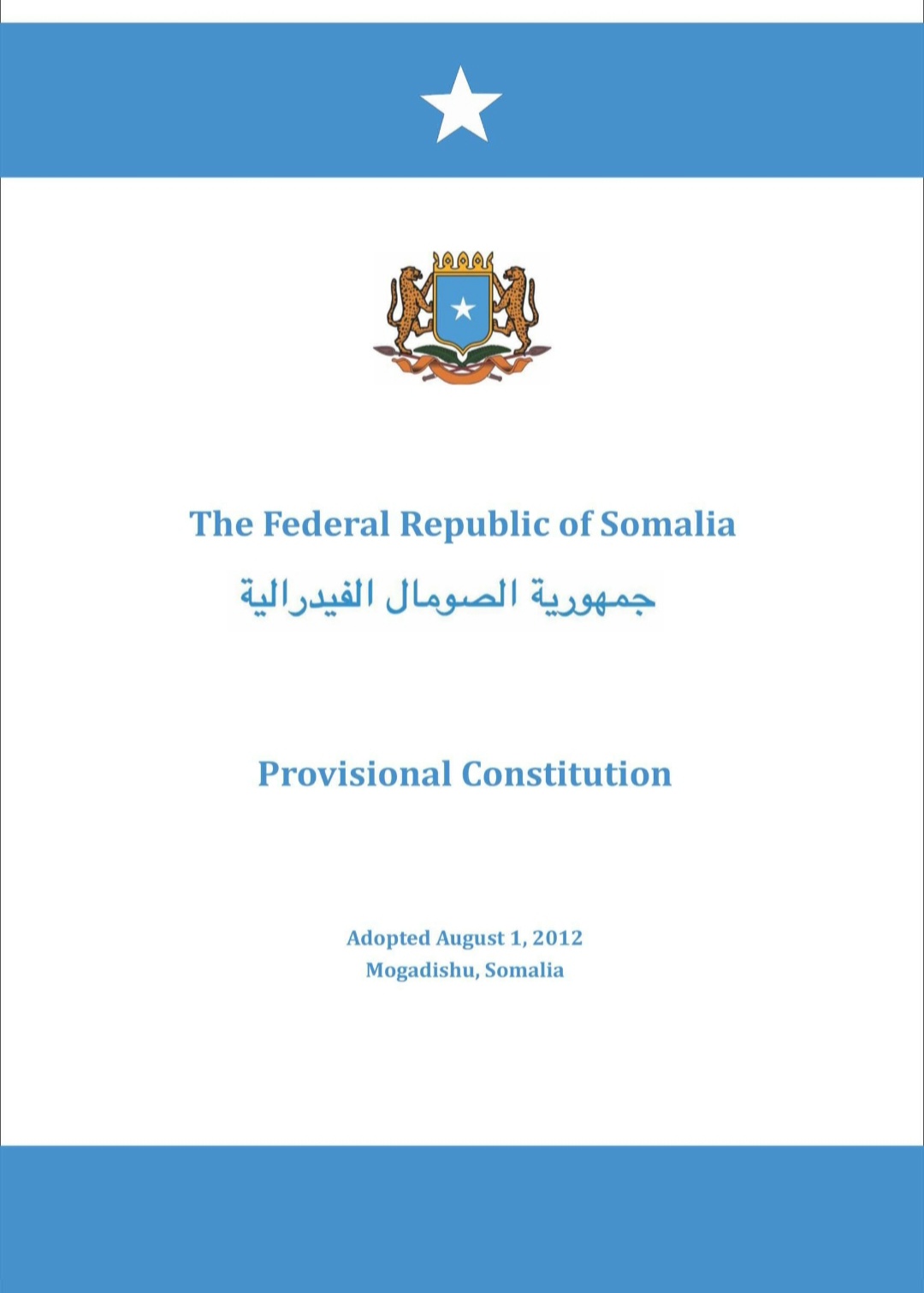
3.2 The 2012 Provisional Constitution and subsequent amendments
The Provisional Federal Constitution was adopted on 1 August 2012. The International Labour Organization’s NATLEX entry records an amending text dated 30 March 2024 relating to Chapters 1–4. The Office of the Prime Minister likewise describes those amendments as effective from 30 March 2024. The official Presidency website, however, describes a Constitution approved by Parliament on 4 March 2026 and signed on 8 March 2026 as the permanent supreme law. Other official and independent sources report that the 2026 process addressed additional chapters.
These sources demonstrate that the constitutional position requires careful legal reconstruction. They do not, on their own, resolve all disputes about the procedure, legitimacy, or acceptance of the 2026 text. The final report must compare: the full text adopted; the relevant amendment clauses; parliamentary quorum and voting records; the legal role of both chambers; publication and commencement records; any referendum or consultation requirements; positions of Federal Member States; and any court decisions on validity.
3.3 Verification protocol
1. Obtain the official Somali-language constitutional text and the complete English translation, including all schedules and transitional provisions.
2. Obtain the 2012 text, the 2024 amendments, the 2026 consolidated text, and any official explanatory or implementation materials.
3. Verify the parliamentary resolutions, voting records, dates, quorum information and signature or promulgation records.
4. Identify the applicable constitutional amendment procedure and compare the documented process with that procedure.
5. Record positions of federal institutions and Federal Member States without treating political statements as judicial determinations.
6. Search for any competent court ruling on the validity, interpretation or effect of the amendments; if none is located, state that no such ruling was identified in the reviewed sources.
7. Explain the practical implications of any unresolved status issue for the legal analysis and recommendations.
3.4 Constitutional rights and Sharia clauses
The constitutional framework contains provisions relevant to fundamental rights, the state’s relationship with Islam, and the compatibility of legislation with the general principles and objectives of Sharia. The final report must quote the exact text and article numbers from the constitutional version found to be applicable. It should analyse how these clauses interact with equality, non-discrimination, freedom of religion or belief, fair trial, personal liberty, and other rights, using relevant domestic and international authorities.
3.5 Federalism and division of powers
The distribution of legislative and administrative competence between federal institutions and Federal Member States is a central issue for harmonisation. The report should map exclusive, shared, and unresolved competencies; identify relevant constitutional provisions and intergovernmental agreements; and compare these with actual legislation and administrative practice. Recommendations should not presume that uniformity is always constitutionally required. The objective is legal clarity, minimum rights protection and effective cooperation within the constitutional framework.
3.6 Constitutional reform assessment
Issue Evidence to collect Question for analysis
Text and publication Authoritative constitutional versions and gazette records Which text is formally promulgated and applicable at the research cut-off?
Procedure Constitutional amendment clauses, parliamentary records Were required procedures followed? What legal consequences follow from any alleged defect?
Federal participation Meeting records, agreements, formal positions What role do member states have in the relevant constitutional process?
Rights Bill of Rights and treaty obligations Are protections sufficiently clear and enforceable?
Judicial review Judgments and jurisdictional rules Which body can interpret or review constitutional disputes?
Implementation Enabling laws and institutional practice Which provisions require implementing
legislation or institutional action?
4. Sources of Law: Sharia, Xeer and Statutory Law
4.1 A plural system requires source-by-source analysis
A legal map should not assume that one source uniformly overrides every other source in every context. The hierarchy and interaction of norms must be established from the applicable constitutional text, legislation, court jurisdiction, recognised practices and relevant decisions. The report should differentiate legal validity, social legitimacy, institutional use and practical accessibility.
4.2 Sharia
Research should identify the legal fields in which Sharia is applied, the legal authority relied upon, the decision-makers applying it, and the procedural safeguards available to the parties. It should also record variation in interpretation. The report should not attribute a contested interpretation to all scholars or communities without evidence. Where a practice is alleged to conflict with a right, the analysis should identify the precise practice, the right involved, applicable domestic law and international obligations, and the available remedy.
4.3 Xeer
Xeer is generally an oral customary normative system that may draw on agreements, precedent, mediation and collective understandings between groups. It can provide accessible dispute resolution where formal justice is distant, expensive or unavailable. At the same time, research has identified concerns in some settings about collective responsibility, the role of women in proceedings, and the rights of individuals whose interests may not be adequately represented by elders.
The report should therefore assess both access-related strengths and rights-related risks. It should examine whether affected individuals can participate meaningfully, whether outcomes are voluntary and informed, whether serious crimes are referred to competent authorities, whether remedies are discriminatory, and whether there is access to review or protection from coercion.
4.4 Statutory legislation and inherited codes
Statutory law includes the Constitution, parliamentary statutes, decrees or instruments adopted under recognised legal authority, regulations, and other legally valid instruments. Inherited codes must be assessed according to their formal adoption and subsequent legal history. The fact that a law was influenced by a colonial system does not automatically invalidate it; nor does its continued citation prove that every provision remains applicable.
4.5 Conflict-of-laws method
8. Identify the forum and the legal question before deciding which source governs.
9. Establish the applicable constitutional and statutory hierarchy from the authoritative text.
10. Identify any specific legislation recognising, regulating or limiting customary or religious jurisdiction.
11. Examine whether the parties had meaningful access to formal justice and whether any waiver or settlement was voluntary and lawful.
12. Test the applicable rule and remedy against constitutional rights and binding international obligations.
13. Record any uncertainty in the law or inconsistent practice as a research finding, rather than resolving it through assumption.
4.6 Recommended interface between systems
Reform should focus on clear jurisdictional rules, minimum procedural safeguards, accessible referrals, protection against coercion, and effective remedies. It should not assume that all disputes must be resolved through one mechanism or that customary mechanisms should be abolished. Serious criminal offences and violations of nonderogable rights require particular attention to state duties to prevent, investigate, prosecute where appropriate, and provide remedies.
5. Criminal Law and Inherited Legislation
5.1 Penal Code
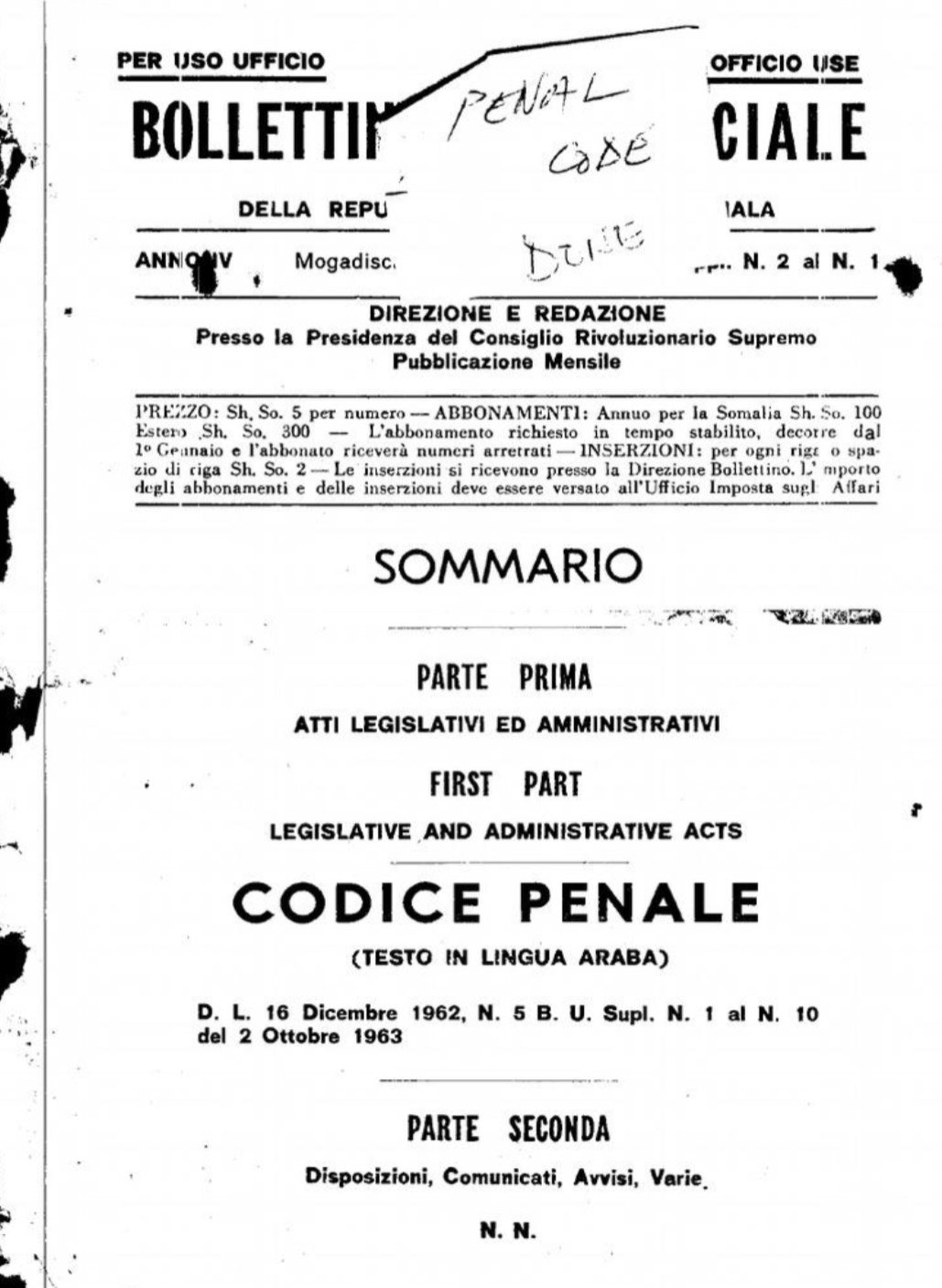
The Penal Code was approved by Legislative Decree No. 5 of 1962 and entered into force on 3 April 1964. The text has been widely referenced as a continuing basis for criminal law, but a comprehensive audit must verify its current status alongside subsequent legislation and regional differences. The report should not describe the entire Code as invalid or obsolete solely because of its age. It should identify individual provisions requiring amendment, repeal, interpretation or confirmation.
5.2 Priority provisions for review
The detailed review should prioritise provisions affecting: legality and foreseeability of criminal offences; penalties; public-order and morality offences; defamation and media-related offences; national security and counter-terrorism; discrimination; gender-based violence; sexual offences; child protection; torture and ill-treatment; and the treatment of persons with disabilities or mental health needs in criminal proceedings. The selection should be driven by evidence and legal significance, not an assumption that every listed topic is governed by a single provision.
5.3 Legality, proportionality and freedom of expression
Criminal offences should be sufficiently clear and foreseeable, and penalties should be consistent with constitutional safeguards and applicable human-rights obligations. Restrictions on expression require particular scrutiny of legal clarity, legitimate aim, necessity and proportionality. The report should compare the exact statutory language with relevant treaty standards and domestic practice, including prosecutions or administrative actions against journalists, media workers, activists and HRDs.
5.4 Criminal Procedure Code
The Criminal Procedure Code of 1963 governs important aspects of criminal process, including jurisdiction, parties, investigation, arrest, summonses, custody, bail and other procedural matters. The legal audit should verify each relevant provision against constitutional guarantees and international standards, with particular attention to access to counsel, prompt judicial review of detention, presumption of innocence, disclosure, impartiality, exclusion of evidence obtained through torture or coercion, appeal rights, and remedies for unlawful detention.
5.5 Juvenile justice
The report should examine the legal definition of a child, minimum age of criminal responsibility, diversion, detention as a last resort, separation from adults, privacy, rehabilitation and child-sensitive proceedings. Different statutes may use inconsistent age thresholds or terminology. Such inconsistencies should be recorded in a matrix with the exact provisions, affected groups, applicable treaty standards, and proposed amendments.
5.6 Prison legislation and detention safeguards
Contemporary legal-framework reporting identifies prison-related instruments dating from 1972 and prison regulations from 1984, as well as concerns about explicit torture prohibitions, solitary confinement, outdated rules and differences between regional frameworks. These findings should be treated as a strong starting point for verification. The report must obtain the authoritative texts, confirm dates and amendments, and determine whether newer legislation has been enacted since the cited assessment.
A modern detention framework should provide clear prohibitions of torture and ill-treatment; independent monitoring; medical care; family contact; separation of children and adults; safeguards for women and other at-risk detainees; accessible complaints; investigation of deaths and injuries; and judicial remedies. Solitary confinement should be assessed against applicable international standards, including restrictions on its use and safeguards against prolonged or indefinite isolation.
5.7 Anti-terrorism and security legislation
Security legislation should be reviewed for precision, safeguards against arbitrary detention, judicial oversight, fair-trial guarantees, treatment of children associated with armed groups, and the protection of journalists and HRDs. The report should distinguish legitimate security objectives from the legal requirements governing necessity, proportionality, due process and accountability.
5.8 Legislative review method
Step Required work product
1. Identify Exact title, number, date, issuing authority and official text.
2. Establish status Commencement, amendments, repeals, superseding laws and territorial application.
3. Map provisions Article-by-article list of relevant offences, powers, rights and procedures.
4. Compare standards Constitutional guarantees and binding treaty obligations, with precise citations.
5. Test practice Cases, prosecution data, monitoring reports, interviews and documented outcomes.
6. Recommend Specific amendment, repeal, replacement, regulation, training or enforcement action.
7. Validate Legal peer review and consultation with affected communities and institutions.
6. Courts, Judicial Practice and Jurisprudence
6.1 What counts as jurisprudential evidence
A report about jurisprudence must rely on judicial decisions and the reasoning contained in them. Statutes, policy reports, interviews and secondary commentary are important context but cannot alone establish what a court has held. The final report should identify the court, case number, date, parties where lawful to disclose, legal issue, relevant statutory provisions, holding, reasoning, remedy, appeal history and source.
6.2 Institutional mapping
The research should map the Supreme Court, relevant federal courts, Federal Member State court structures, prosecution authorities, judicial service bodies and any constitutional review mechanism under the applicable constitutional framework. It should verify the current legal basis and jurisdiction of each institution rather than assuming that institutional names or powers have remained unchanged through constitutional reform.
6.3 Access to judgments
The availability of reasoned judgments is a prerequisite for evaluating consistency, legal certainty and judicial accountability. CSHRD should determine whether judgments are published online, available in Somali or English, indexed by subject, and accessible to lawyers and the public. Where decisions are not public, the report should explain how the research obtained or attempted to obtain them, subject to confidentiality and safety.
6.4 Proposed case-law search strategy
14. Request judgment registers and published decisions from relevant courts and judicial institutions.
15. Search official repositories and legal-information platforms, including SomLII, while checking repository copies against source documents where possible.
16. Search for decisions concerning constitutional interpretation, criminal procedure, detention, freedom of expression, gender-based violence, customary justice, and federal-state competence.
17. Record negative search results transparently; absence from an online database does not prove that no case exists.
18. Seek corroboration from legal practitioners and academic researchers without treating recollection as a substitute for the judgment.
19. Translate relevant Somali-language judgments accurately and retain the original text alongside the translation.
6.5 Analytical framework for each judgment
Field Questions
Jurisdiction Did the court have authority over the parties, subject matter and remedy?
Legal sources Which constitutional provisions, statutes, treaties, Sharia principles or customary norms were cited?
Interpretation How did the court interpret the relevant text and resolve conflicts?
Rights reasoning Were rights identified, limited, balanced or omitted? Was the reasoning legally supported?
Procedure Were parties heard, counsel available, evidence tested and reasons provided?
Remedy Was the remedy effective, enforceable and proportionate?
Precedential value Is the decision binding, persuasive, frequently followed, or of uncertain status?
Appeal and enforcement Was it appealed, reversed, complied with or otherwise implemented?
6.6 Current evidentiary limitation
At this draft stage, a sufficiently verified and representative set of Somali court judgments has not been assembled to support broad conclusions about the consistency of judicial reasoning nationwide. The report therefore does not invent case citations or claim a comprehensive jurisprudential survey. A dedicated case-law collection phase is required before the final report can make definitive findings about judicial doctrine or patterns of decisions.
7. International and Regional Human Rights Obligations
7.1 Treaty inventory
The report should build its treaty analysis from official depositary records, particularly the United Nations Treaty Collection, OHCHR treaty-body database, and African Union or other competent depositary records. Ratification, accession, entry into force, reservations, declarations, reporting status and individual complaint mechanisms must be recorded separately. Signature alone should not be described as ratification.
Instrument / standard Relevance Status and application check
International Covenant on Civil and Political Rights (ICCPR) Life, liberty, fair trial, expression, association, equality and effective remedy OHCHR records Somalia’s accession in January 1990; verify current depositary details and any reservations.
Convention against Torture (CAT) Absolute prohibition of torture, prevention, investigation, remedies OHCHR records accession in January 1990; verify current status and reporting materials.
Convention on the Rights of the Child (CRC) Child definition, juvenile justice, protection and participation Verify official treaty status, protocols and relevant concluding observations.
Convention on the Elimination of All Forms of Discrimination against Women (CEDAW) Gender equality and protection against discrimination Verify current ratification status; do not assume ratification from policy commitments.
International Convention on the Elimination of All Forms of Racial Discrimination (ICERD) Racial discrimination and equal protection Verify treaty status and reporting obligations.
African Charter on Human and Peoples’ Rights Regional rights guarantees and state obligations AfricanLII and UN depositary sources list Somalia’s ratification; verify original depositary record.
African Charter on the Rights and Welfare of the Child Regional child-rights standards Verify ratification and current domestic implementation.
African Union Convention for the Protection Protection and assistance for internally AfricanLII records Somalia’s ratification and
and Assistance of Internally Displaced Persons in Africa (Kampala Convention) displaced persons entry into force; confirm official depositary details.
UN Standard Minimum Rules for the
Treatment of Prisoners (Nelson Mandela Rules) Authoritative non-treaty standards for detention Use as interpretive guidance, while distinguishing standards from binding treaty provisions.
Basic Principles on the Role of Lawyers and related UN standards Legal representation, independence and fair administration of justice Use as standards and guidance; distinguish their legal status from treaties.
7.2 Treaty-to-law mapping
For each binding treaty obligation, the report should identify: (i) the relevant treaty article; (ii) the authoritative interpretation, where available; (iii) the domestic constitutional or statutory provision; (iv) the institution responsible; (v) evidence of implementation; and (vi) any gap and proposed remedy. The analysis should distinguish direct applicability in domestic courts from obligations requiring legislative or administrative implementation.
7.3 Universal Periodic Review and UN mechanisms
Somalia underwent its fourth-cycle Universal Periodic Review in May 2026. The report should review the national report, UN compilation, stakeholder submissions, recommendations, responses and outcome documents. It should also examine relevant reports of the Human Rights Council, OHCHR, treaty bodies, Special Procedures and the independent expert on the situation of human rights in Somalia. Recommendations should be coded by topic and status—accepted, noted, implemented, partially implemented or outstanding—using the official records.
7.4 International standards are not interchangeable
The Universal Declaration of Human Rights, treaty provisions binding on Somalia, treaty-body interpretations, UN General Assembly standards, and policy recommendations do not all have the same legal status. The report must identify the source and its legal character, avoiding the blanket claim that every international instrument is legally binding in the same way.
8. Thematic Human Rights Compliance Review
8.1 Right to liberty and fair trial
The assessment should examine arrest powers, warrants, custody periods, prompt judicial control, access to counsel, disclosure of evidence, presumption of innocence, impartiality, public hearings, reasoned judgments, appeal and remedies for unlawful detention. Each finding must cite the relevant domestic provision and applicable international standard. Where practice differs by region or institution, the report should specify the setting and evidentiary basis.
8.2 Torture and ill-treatment
The legal review should identify whether torture is comprehensively defined and criminalised; whether penalties reflect the gravity of the offence; whether investigations are independent and prompt; whether evidence obtained by torture is excluded; whether victims can access redress and rehabilitation; and whether complaints mechanisms are safe and effective. Constitutional prohibitions, prison rules and general assault offences should not automatically be treated as a complete substitute for a comprehensive anti-torture framework.
8.3 Women and girls
The report should review laws and practices concerning sexual and gender-based violence, female genital mutilation, child and forced marriage, discrimination in family and property matters, access to legal aid, evidentiary rules, and protection from retaliation. It should document whether relevant bills have been enacted, amended or remain pending. Recommendations should be informed by women’s organisations and survivors, using trauma-informed and confidential research practices.
8.4 Children and juvenile justice
The research should compare age thresholds and procedural safeguards across the Penal Code, child-protection and juvenile-justice legislation, and regional instruments. It should examine diversion, detention as a last resort, rehabilitation, privacy, separation from adults, and safeguards for children affected by armed conflict. The report should not infer the status of a bill from a press announcement; enactment and commencement must be verified.
8.5 Freedom of expression, association and civic space
The Penal Code, media laws, counter-terrorism laws and other public-order provisions should be assessed for legal certainty, necessity, proportionality and compatibility with protected expression. Case studies should document arrest, detention, prosecution, licensing action or other restrictions affecting journalists, HRDs and civil society, with source verification and right of reply where appropriate.
8.6 Equality and protection of minorities
The review should assess formal equality guarantees and practical access to justice for minority and marginalised communities. It should examine discrimination in policing, court access, legal representation, customary processes, property and inheritance disputes, and participation in decision-making. Findings should be based on disaggregated evidence where safe and methodologically appropriate.
8.7 Access to justice and legal aid
A rights guarantee is weakened when people cannot afford counsel, travel to a competent court, understand proceedings, obtain documents, or enforce judgments. The report should map legal aid providers, eligibility criteria, geographical reach, language access, procedural barriers, and complaint mechanisms. It should also consider the safety and independence of lawyers and HRDs who document abuses.
8.8 Economic, social and environmental rights
The legal inventory should cover relevant rights and duties concerning labour, education, health, housing, land, property, water, environmental protection and displacement. The report should distinguish enforceable legal obligations from policy commitments and identify available remedies, institutional mandates, and gaps in implementation.
8.9 Counter-terrorism, armed conflict and accountability
Security and conflict-related legislation should be assessed against applicable international human rights law and, where relevant, international humanitarian law. The report should examine detention, fair trial, accountability for abuses, child protection, civilian harm, and safeguards against misuse of security powers. The analysis must avoid conflating all security operations or all affected communities.
9. Federalism, Legal Pluralism and Territorial Variation
9.1 Why regional mapping is necessary
A national report can be misleading if it treats every law or institution as applicable throughout all Somali territories. The legal position may differ between the Federal Government and Federal Member States, while Somaliland operates its own constitutional and institutional framework. Puntland and other regional administrations may also have specific legislation or judicial arrangements. The final report should record jurisdiction and territory for every legal instrument and case.
9.2 Federal Member State inventory
For each Federal Member State, CSHRD should record: applicable constitutional or foundational instruments; court organisation laws; criminal and civil legislation; prison laws; police and prosecution mandates; legislation on women, children, media and civil society; and any formal arrangements for cooperation with federal institutions. It should identify whether each instrument is enacted, in force, superseded, pending, or uncertain.
9.3 Somaliland as a separate analytical section
Somaliland’s legal and constitutional framework should be analysed in a separate section, with clear terminology and source attribution. The report should distinguish Somaliland’s own constitutional claims and institutions from the Federal Republic’s constitutional framework, without collapsing distinct legal systems or making unsupported conclusions about international status.
9.4 Harmonisation without over-centralisation
Harmonisation should aim to reduce uncertainty and ensure effective rights protection while respecting the constitutionally applicable distribution of powers. It may involve model laws, intergovernmental agreements, minimum safeguards, shared data standards, judicial cooperation and common training. The report should not recommend centralisation where the relevant constitutional competence is shared, reserved or disputed without first analysing the legal basis.
9.5 Regional comparison table
Field Federal level Federal Member States Somaliland Evidence gap
Constitutional basis Verify applicable federal text Identify state instruments and relation to federal law Separate constitutional order Current authoritative texts and procedural status
Criminal law Map federal statutes Identify additional or divergent provisions Map Somaliland statutes and applicable codes Article-level comparison
Courts Verify court structure and jurisdiction Map each state’s courts and appeals Map institutions separately Current laws and case law
Prisons Map federal instruments Identify regional prison laws Identify Somaliland prison framework Inspection and implementation evidence
Customary justice Map legal recognition and interfaces Document regional practice Document local arrangements Safeguards and referral mechanisms
Human rights institutions Verify mandates and independence Map regional mandates Map local institutions Resources, powers and practice
10. Findings: Legal and Jurisprudential Gaps
The following are preliminary research findings and issue areas, not final determinations that every identified gap exists throughout Somalia. Each must be validated against the current legal text, jurisdiction, and evidence.
10.1 Constitutional certainty
Official sources describe the constitutional developments of 2024 and 2026 in different terms. The legal audit should determine the authoritative text and examine procedural objections and regional positions. Until the primary records are compared, recommendations dependent on particular article numbers or constitutional allocations should be marked provisional.
10.2 Outdated and fragmented legislation
The continued reference to criminal and prison-related instruments dating from the 1960s, 1970s and 1980s supports a systematic review. It does not, by itself, prove that each provision is invalid. The gap is the absence of a single publicly accessible, fully verified inventory in this research draft that records current status, amendments, repeals and territorial application for every major instrument.
10.3 Accessibility of jurisprudence
A comprehensive evaluation of judicial interpretation requires a searchable and representative set of judgments. The present draft has not yet established such a dataset. The report should treat publication, access, translation and indexing of decisions as both a research need and a possible reform priority, subject to confirmation of current systems.
10.4 Interface between legal systems
The interaction between statutory law, Sharia and Xeer creates questions about jurisdiction, individual rights, remedies, and consistency. Specific concerns in customary dispute resolution—such as collective responsibility or unequal participation—must be documented with careful attention to variation. A rights-compatible interface should preserve access and local legitimacy while protecting individual rights and access to formal remedies.
10.5 Human rights implementation
International treaty obligations and constitutional rights must be translated into clear legislation, effective institutions, accessible remedies and consistent practice. The report should measure implementation using official data, case studies, monitoring reports, court records, and confidential interviews. It should distinguish the existence of a legal prohibition from the ability of victims to obtain an effective remedy.
10.6 Federal and regional inconsistency
Differences in legislation and institutional capacity may create uncertainty or uneven protection. The final report should establish which differences are constitutionally permitted, which require coordination, and which create rights-related problems. It should avoid describing all regional variation as unlawful.
10.7 Data and institutional capacity
The availability and reliability of statistics on arrests, detention, prosecutions, appeals, legal aid, prison inspections, torture complaints, and case outcomes should be assessed. If the data are missing, the report should recommend standardised collection and public reporting rather than present unverified estimates.
11. Reform Options and Implementation Roadmap
11.1 Guiding principles
• Constitutional legality and respect for the applicable allocation of powers.
• Compliance with binding international human rights obligations.
• Legal certainty, accessibility, foreseeability and consistency.
• Equality, non-discrimination and meaningful participation of affected communities.
• Judicial independence, impartiality and effective remedies.
• Context-sensitive engagement with Sharia and Xeer, while safeguarding individual rights.
• Transparent evidence, consultation, public reporting and measurable implementation.
11.2 Immediate priorities: first six months
Action Lead / partners Output Indicator
Complete authoritative legal inventory CSHRD research team; Ministry of Justice, Attorney General, parliaments, legal repositories Verified database of priority instruments Share of instruments with primary text, status and territorial scope verified
Resolve constitutional-source record Legal researchers; official parliamentary and constitutional bodies; independent experts Dossier comparing texts, procedures and institutional positions All relevant official versions and procedural records logged
Launch criminal-law audit Criminal-law experts, bar associations, HRDs, women’s and child-rights groups Article-by-article Penal and Procedure Code matrix Priority provisions classified and legally reviewed
Build case-law collection Courts, legal practitioners, universities, legal information platforms Searchable jurisprudence dataset Number of verified judgments indexed, translated and tagged
Map treaty obligations and UPR recommendations Human-rights experts and civil society Treaty-to-law and UPR implementation matrices Each priority recommendation assigned a status and responsible institution
11.3 Medium-term priorities: six to eighteen months
Action Expected result Implementation safeguard
Draft amendments to priority criminal provisions Clearer offences, penalties and safeguards Public consultation; compatibility review; Somali-language drafting
Review prison and detention legislation Modern detention standards and oversight Independent inspection, complaint and remedy mechanisms
Strengthen juvenile justice Child-sensitive procedures and detention safeguards Participation of child-protection specialists and affected communities
Improve legal aid and judgment publication More accessible justice and transparent jurisprudence Privacy, security and protection for vulnerable parties
Develop federal-state coordination mechanisms Reduced legal uncertainty and improved cooperation Respect for constitutional competences and meaningful state participation
Support rights-compatible customary justice interfaces Clear referrals, safeguards and remedies Avoid coercive formalisation; include women and minority communities
11.4 Longer-term priorities: eighteen to thirty-six months
• Establish a continuing legislative review mechanism with public progress reports.
• Develop a national system for publication and indexing of judgments, with privacy safeguards.
• Integrate human-rights training into judicial, prosecutorial, police, prison and legal-profession education.
• Strengthen independent monitoring of detention facilities and follow-up on recommendations.
• Create public indicators for access to justice, case duration, legal aid, prison conditions and implementation of court decisions.
• Evaluate reforms with independent civil society participation and publish progress against a baseline.
11.5 Monitoring framework
Outcome Suggested indicator Data source Frequency
Improved legal certainty Priority laws with verified current status and consolidated text Official gazettes, ministries, parliaments, legal repositories Six-monthly
Stronger fair-trial safeguards Cases with documented access to counsel and timely judicial review, where data are available Court and legal aid records; monitoring reports Annual
Improved detention safeguards Facilities inspected; complaints investigated; recommendations implemented Inspection bodies, ministries, independent monitors Six-monthly
Better jurisprudential access Reasoned judgments published and searchable, with appropriate redactions Courts and legal information platforms Annual
Improved human-rights compliance Priority UPR and treaty recommendations with verified implementation evidence Official reports and civil society monitoring Annual
More inclusive reform Consultations with women, minorities, youth, HRDs and
regional stakeholders documented Consultation records and independent evaluation At each reform stage
11.6 Risk management
Risk Mitigation
Political disagreement over constitutional status Use neutral legal analysis; distinguish law, institutional position and political claim.
Uneven access to primary texts Request official copies; triangulate sources; flag unverified status.
Security risks for interviewees Use informed consent, anonymisation, secure storage and do-no-harm protocols.
Regional variation obscured by national averages Disaggregate by jurisdiction and identify sample limitations.
Reform recommendations not implemented Assign responsible bodies, deadlines, indicators and public follow-up.
Overgeneralisation about Sharia or Xeer Use contextual evidence and consult diverse legal and community experts.
Translation errors Retain original text, document translation method and obtain legallanguage review.
12. Conclusion
Somalia’s legal modernisation requires more than replacing old statutes or adopting new laws. It requires a verified understanding of the legal sources currently applicable, clear constitutional and institutional authority, accessible jurisprudence, effective safeguards in practice, and realistic implementation arrangements. The coexistence of statutory law, Sharia and Xeer makes careful source analysis especially important.
For CSHRD, the most defensible contribution is a report grounded in primary texts, verified case law, treaty records, regional comparison and documented experiences of people seeking justice. The report should identify the specific rule or practice at issue, explain the legal standard, assess evidence of implementation, and propose a feasible remedy. It should be rigorous about uncertainty and avoid claims that cannot be supported by the available record.
The immediate next phase is source validation: establish the current constitutional text and procedure; complete the legislative inventory; collect and analyse judgments; verify treaty status; and obtain region-specific implementation evidence. Only after that work should the final report classify provisions as incompatible, outdated, inconsistent or in need of amendment. This process will strengthen the report’s credibility as an institutional CSHRD publication and its usefulness to Somali legal reform stakeholders.
Annex A. Preliminary Legal Inventory
Instrument / source Known date or reference Subject Status in this draft
Constitution of the Federal
Republic of Somalia / Provisional Federal Constitution 2012; amendments in 2024 and
2026 reported Constitutional order, rights, federalism, institutions High-priority verification;
conflicting official descriptions must be reconciled
Penal Code, Legislative Decree No. 5 Approved 1962; effective 3 April 1964 Criminal offences and penalties Text identified; article-by-article status audit required
Criminal Procedure Code 1963 Criminal jurisdiction, investigation, arrest, trial and procedure Text available through legal
repository; verify official source
and amendments
Organization of the Judiciary Law 1962; later judiciary legislation also reported Court organisation and judicial institutions Obtain authoritative current text and subsequent laws
Organization of the Judiciary legislation 1974 instrument listed by
Attorney General’s Office Judiciary organisation Relationship to later laws and current status requires verification
Somali Prison Law Often cited as 1972; some sources refer to 1971 Prison administration and detainee treatment Verify exact title, date, text and amendment history
Somali Custodial Corps Act 1972 cited in contemporary sources Custodial institutions Verify primary text and current status
Regulation for the Country’s Prisons 1984 cited in contemporary sources Prison operations and safeguards Verify current applicability and later regulations
Anti-terrorism legislation Various enactments and proposals; exact inventory required Security powers and criminal liability Compile complete
title/date/amendment register
Media and communications laws Multiple federal and regional instruments Media regulation and expression Compile current inventory and review compatibility
Child-protection / juvenile-justice laws Recent legislation and reform initiatives reported Child protection and justice Verify enacted text, commencement and territorial application
Gender-based violence legislation Bills and laws may differ by jurisdiction Violence prevention, investigation and remedies Verify current enactment and regional status
Labour Code Revised Labour Code reported in UN materials Employment and labour rights Obtain official text,
commencement and regulations
African Charter on Human and Peoples’ Rights Somalia ratification recorded in depositary sources Regional human rights obligations Verify official depositary record and domestic implementation
ICCPR Somalia accession recorded in UN treaty records in January 1990 Civil and political rights Verify reservations/declarations and current reporting status
CAT Somalia accession recorded in UN treaty records in January 1990 Torture prevention and remedies Verify reservations/declarations and current reporting status
CRC Treaty status to be checked against official record Child rights Complete status and reporting review
CEDAW Current ratification status must be verified Gender equality Do not assume ratification; record exact official status
Kampala Convention Somalia ratification recorded in African legal databases Internally displaced persons Confirm depositary record and implementation measures
Annex B. Legal Gap Analysis Matrix
ID Issue to test Primary evidence Human-rights / constitutional test Proposed action if gap confirmed
G-01 Constitutional text and amendment validity 2012 text, 2024 amendments, 2026 text, parliamentary records, gazette Amendment procedure,
legal certainty, institutional authority Publish verified consolidated text and authoritative legal-status explanation
G-02 Criminal offences
insufficiently clear or overbroad Penal Code provisions and prosecution decisions Legality, foreseeability, necessity, proportionality Amend, narrow or repeal identified provisions
G-03 Procedural safeguards inconsistent or ineffective Criminal Procedure Code, cases, detention records Liberty, fair trial, effective
remedy Revise procedures and strengthen judicial
oversight
G-04 Torture prohibition or accountability gaps Constitution, penal law,
prison rules, complaint files CAT and constitutional prohibition; investigation and redress Adopt or strengthen comprehensive antitorture framework
G-05 Prison standards outdated or fragmented Prison laws, regulations, inspection reports Dignity, humane treatment, health and monitoring standards Update prison law and establish independent
monitoring
G-06 Child age and juvenile safeguards inconsistent Penal Code, child legislation, case files CRC and other applicable child-rights obligations Harmonise age definitions and procedures
G-07 Gender-based violence protections incomplete Criminal law, bills, judgments, survivorservice data Equality, bodily integrity, access to justice Adopt or revise legislation and victim-protection procedures
G-08 Expression-related
offences or enforcement unduly restrictive Penal Code, media laws, prosecutions Freedom of expression and permissible restrictions Narrow offences and
ensure proportionality and remedy
G-09 Xeer proceedings lack
adequate individual
safeguards Documented proceedings, interviews, agreements Equality, participation, protection from coercion and access to remedy Create rights safeguards and referral pathways
G-10 Judgments unavailable or inconsistent Court registers, verified judgments, appeals Legal certainty, reasoned decisions, effective
remedy Publish searchable judgments with appropriate privacy safeguards
G-11 Federal-state rules create uncertainty Federal and state laws, agreements, cases Constitutional division of powers and equality before law Clarify competencies and develop agreed minimum safeguards
G-12 Treaty obligations not
reflected in domestic law or practice Treaty status, laws, UPR and treaty-body records Binding treaty obligations and authoritative interpretation Create treaty-to-law implementation plans and public reporting
Annex C. Jurisprudence Extraction Template
Field Entry to be completed for each case
Case citation / number
Court / jurisdiction
Date of decision
Parties / anonymisation
Procedural history and appeal
Facts material to the legal issue
Legal questions
Constitutional provisions relied upon
Statutes and articles relied upon
Treaties or international standards cited
Sharia / Xeer principles considered, if any
Holding / disposition
Reasoning and interpretation
Rights analysis and limitations
Remedy and enforceability
Precedential or persuasive status
Source URL / official copy / language
Translation and verification notes
Relevance to report findings
Annex D. Stakeholder Interview Guide
Interviews should be voluntary, confidential where requested, and conducted under a written research and safeguarding protocol. The interviewer must explain the purpose, intended use, risks, data handling and right to withdraw. Do not collect identifying details that are unnecessary for the research.
20. Which laws or legal sources are most commonly used to resolve disputes in your area, and how do people decide which forum to approach?
21. What barriers prevent people from accessing formal courts, legal aid or effective remedies?
22. How are decisions from customary or religious forums referred to or reviewed by formal institutions, if at all?
23. Which laws or procedures are most difficult to apply because they are unclear, outdated or inconsistent?
24. Are judgments and legislation readily accessible in Somali and other languages needed by the community?
25. What procedural safeguards are available to people accused of offences, survivors of violence, children and detainees?
26. What challenges do women, minority communities, displaced people, persons with disabilities and HRDs face when seeking justice?
27. Which reforms would be feasible in the next 6–18 months, and which institutions should lead them?
28. What documents, cases or data could verify the issues discussed?
29. Are there safety risks associated with participating in this research or being identified in the report?
Annex E. Source Register and Verification Checklist
Source Use in report Verification note
Office of the President, Federal Republic of Somalia — Constitution page Official account of the 2026 Constitution and claimed status Compare the full published text with parliamentary records and other official accounts.
Office of the Prime Minister — Amendments to Chapters 1–4 Official account of 2024 amendments and effective date Check the linked PDF and reconcile with 2026 consolidated text.
Ministry of Interior, Federal Affairs and
Reconciliation — Federal Constitution page Historical constitution inventory Verify source links and texts; treat metadata as an index, not final legal proof.
Office of the Attorney General — Legislations page Judiciary legislation and constitutional materials Obtain each linked instrument and verify enactment, amendments and current status.
Refworld — Somalia Penal Code Primary-text repository for Penal Code Check the underlying national text and any later amendments.
SomLII — Criminal Procedure Code 1963 Accessible text and structure of procedure code Repository warns that it does not authenticate legal status; verify source PDF.
EUAA — Somalia: Displacement in
Mogadishu, Legal and Policy Framework, June 2026 Current secondary overview of prison and criminal justice framework Trace claims to primary law and verify postpublication changes.
OHCHR Treaty Body Database — Somalia country page Treaty status and reporting cycles Check official treaty-depository records for reservations, declarations and entry into force.
AfricanLII — Somalia ratified instruments Regional treaty inventory Confirm ratification and deposit dates against African Union or UN depositary records.
OHCHR / UPR Somalia, fourth cycle 2026 Recommendations, state report and UN compilation Use official documents and record recommendation status precisely.
Somali Public Agenda — constitutional review analysis, March 2026 Independent analysis of the constitutional process Use as secondary analysis; distinguish documented facts from author interpretation.
ConstitutionNet — constitutional review analysis, 2026 Independent constitutional analysis Cross-check procedural claims against official records and other sources.
UNESCO — The Xeer Traditional Legal System of Somalia Context on customary norms and dispute resolution Use for background; supplement with regionspecific and rights-focused research.
Sababi Institute / Knowledge Platform
Security & Rule of Law — Xeer policy brief, 2024 Research on customary justice procedures and reform options Check methodology and avoid treating one study as nationally representative.
Human Rights Watch — World Report 2026: Somalia Human-rights context and reported legislative developments Trace allegations and legal claims to underlying sources where possible.
National Union of Somali Journalists — report Penal Code and anti-terrorism law analysis Obtain full report and verify article-level
on criminalisation of journalism, 2025 analysis.
Pre-publication legal verification checklist
• Every statute cited has an exact title, number, date, source, and status note.
• Every quoted constitutional article is from the authoritative applicable text and translation.
• Every judgment cited has a verified court, date, citation or case number, and source copy.
• Every treaty statement distinguishes signature, ratification/accession, entry into force, reservations and declarations.
• All claims about regional application identify the relevant jurisdiction and evidence.
• All claims about human-rights violations are sourced, attributed and appropriately qualified.
• All interview evidence is consented, securely handled and anonymised where necessary.
• Recommendations identify a responsible institution, proposed action, timeline and indicator.
• Somali legal terminology and translations are reviewed by competent legal-language experts.
• An independent Somali legal scholar or practitioner has peer-reviewed the final draft.
Selected Sources and Further Reading
• Office of the President of the Federal Republic of Somalia, “Constitution” (official page, accessed 29 October 2026). https://villasomalia.gov.so/constitution-2/
• Office of the Prime Minister, “Amendments to the Provisional Constitution of the Federal Republic of Somalia (Chapters 1–4)” (published 22 June 2026). https://opm.gov.so/en/policies/amendments-to-the-provisionalconstitution-of-the-federal-republic-of-somalia-chapters-1-4
• Ministry of Interior, Federal Affairs and Reconciliation, “The Federal Constitution.” https://moifar.gov.so/en/page/federal-constitution
• Office of the Attorney General, “Legislations.” https://ago.gov.so/legislations/ • Refworld, “Somalia: Penal Code” (national legislation, effective 3 April 1964).
https://www.refworld.org/legal/legislation/natlegbod/1964/72335
• Somali Legal Information Institute (SomLII), “Criminal Procedure Code (1963).” https://somlii.org/laws/criminalprocedure-code-1963/
• European Union Agency for Asylum, “3.1. Legal and policy framework,” Somalia: Displacement in Mogadishu (June
2026). https://www.euaa.europa.eu/somalia-displacement-mogadishu/31-legal-and-policy-framework • OHCHR Treaty Body Database, Somalia country page.
https://tbinternet.ohchr.org/_layouts/15/TreatyBodyExternal/countries.aspx?CountryCode=SOM&Lang=EN • AfricanLII, Somalia: ratified documents. https://africanlii.org/en/au/member-state/SO/ • OHCHR, Universal Periodic Review — Somalia, fourth cycle (review date 8 May 2026).
https://wapsphp.test.ohchr.un-icc.cloud/en/hr-bodies/upr/so-index
• Somali Public Agenda, Mahad Wasuge, “Contested Rules, Contested Legitimacy: Somalia’s Constitutional and Electoral Conundrum” (11 March 2026). https://somalipublicagenda.org/contested-rules-contested-legitimacysomalias-constitutional-and-electoral-conundrum/
• ConstitutionNet, “From Provisional to Permanent Constitution? Assessing the End of Somalia’s Constitutional Review Process” (2026). https://constitutionnet.org/ar/node/20092
• UNESCO Intangible Cultural Heritage, “The Xeer Traditional Legal System of Somalia.” https://ich.unesco.org/en/individual-case-study-00988?id=32
• Knowledge Platform Security & Rule of Law, “Policy Brief: Adapting Somali Customary Justice Practices and Procedures” (28 February 2024). https://kpsrl.org/publication/policy-brief-adapting-somali-customary-justicepractices-and-procedures
• Human Rights Watch, “World Report 2026: Somalia.” https://www.hrw.org/world-report/2026/country-chapters/somalia
• National Union of Somali Journalists, “Assessing the Criminalisation of Journalism and Freedom of Expression in Somalia” (21 May 2025 announcement). https://nusoj.org/2025/05/21/new-report-exposes-escalating-legalrepression-of-journalism-and-free-expression-in-somalia/
• United Nations Treaty Collection, African Charter on Human and Peoples’ Rights — Somalia ratification record.
https://treaties.un.org/Pages/showActionDetails.aspx?clang=_en&objid=08000002800cb136